Warehouse build-out financing in 2026: when adding capacity actually pays
Industrial vacancy peaked in early 2026 and the build-out math is shifting back toward growth-justified expansion — here's how 3PLs are funding fit-out, equipment, and owned facilities this cycle.
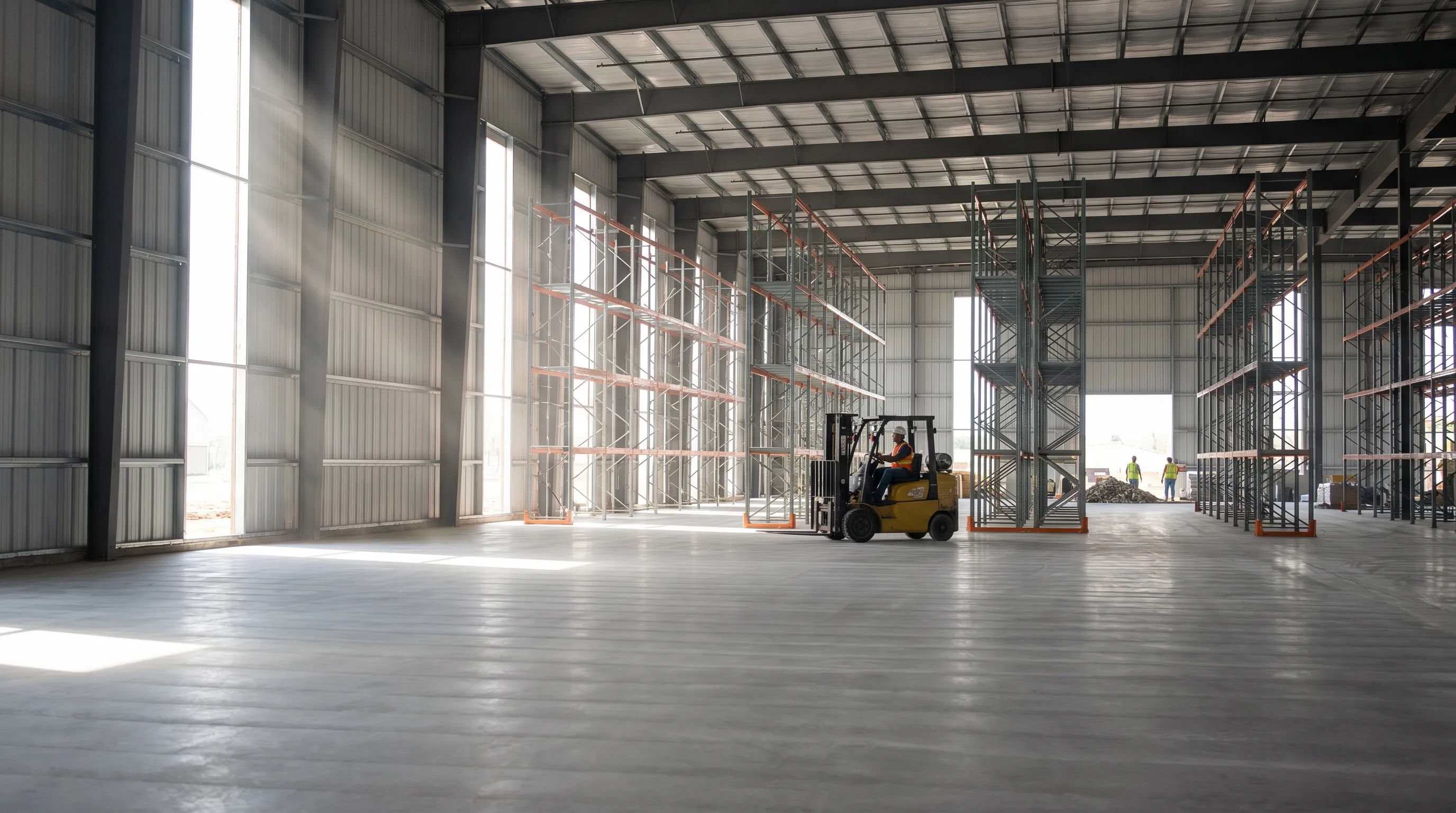
The industrial real estate market 3PLs are building into in 2026 looks structurally different from the one operators were chasing two years ago. National industrial vacancy sat at roughly 6.7 to 7.0 percent in the first quarter of 2026 per Cushman & Wakefield and CBRE — just off the cyclical peak, with Cushman declaring in April that “peak industrial vacancy is likely in the rearview mirror.” Developer-driven oversupply from the 2021–22 build cycle is correcting. Rents in absorbing markets are stable or modestly higher. The opportunistic land-grab pricing that defined 2023–24 deals has largely run its course.
For the 3PL deciding whether to add capacity in 2026, that resets the math in a useful way. The market is no longer rewarding operators who built ahead of demand on the assumption that absorption would catch up. It’s rewarding operators who can underwrite a build-out against committed shipper volume, with payback math that survives the next downturn. Which means understanding what kind of build-out you’re actually financing — because the capital products that fund the three flavors of warehouse expansion are not interchangeable.
Three kinds of build-out, three different lender conversations
“Warehouse build-out financing” gets used as one phrase, but lenders read it as three distinct deals. The financing structure, the rate, and the timeline diverge sharply by category.
Fit-out and TI financing for leased space
The most common build-out a growing 3PL underwrites is the tenant improvement on a leased facility — racking, conveyors, dock equipment, lighting, WMS deployment, sometimes light automation. Industry pricing in 2026 runs roughly $20 to $100 per square foot depending on whether the operator is fitting out a basic cross-dock or a multi-temperature, e-commerce-grade fulfillment box.
Financing structures: landlord-funded TI allowances rolled into rent, dedicated TI loans from specialty equipment lenders, and trade-aware working-capital products that absorb the fit-out spend over five to ten years. Specialty TI lenders that understand warehousing run rates in the 11 to 18 percent range on five to seven-year terms, with funding in days rather than the 60 to 90 days a bank wants. Trade-aware warehouse financing programs underwrite the operator’s revenue stack and named shipper commitments alongside the equipment list, which is what gets a fit-out deal closed on a timeline that matches when the dock doors actually open.
Equipment-only financing
For the operator whose existing footprint just needs more material handling — additional forklifts, a new conveyor run, an AS/RS install, dock levelers — equipment-only financing is the cleanest fit. This is classic asset-secured lending: 24 to 84-month terms, the equipment is the collateral, underwriting focuses on the asset value and the borrower’s payment history rather than the broader operational picture.
Rates in 2026 are running in the 9 to 14 percent range for established 3PLs with clean credit, with longer terms available on heavier capital like AS/RS systems. The trap operators fall into here is financing equipment with working-capital lines instead — same dollar amount, much higher rate, and the wrong product for the cash-flow profile. Equipment debt amortizes against the equipment’s productive life. Working-capital debt should fund variable operating spend, not eight-year fixed assets.
Real estate acquisition and SBA 504
The third category — and structurally the cheapest capital available — is the SBA 504 loan for operators buying the building they’re operating in. SBA 504 funds owner-occupied commercial real estate with 10 percent down, 20 to 25-year terms, and a blended rate that lands well under conventional commercial mortgage pricing. With the prime rate at 6.75 percent as of December 2025, a 504 deal closing today is one of the few financing products in the market still pricing in long-term capital cost rather than near-term risk premium.
The catch is the same one that’s always defined SBA: timeline. A clean 504 deal closes in 60 to 90 days from a fully prepared package; a messy one stretches past four months. For the 3PL converting a long-tenured leased facility into owned property, the discipline of SBA timing is usually worth the structural cost savings. For the operator who needs to open a new market in 90 days, 504 is the wrong product no matter how attractive the rate sheet.
For fit-out work specifically, SBA 7(a) is the parallel option — currently priced at prime plus 2.25 to 2.75 percent, or 9.00 to 9.50 percent today on loans over $50,000, with 10-year typical terms. Meaningfully cheaper than specialty fit-out lenders, with the same 60 to 90-day funding window.
The payback math that matters
Every build-out decision reduces to the same equation, and operators who skip it tend to be the ones explaining a half-empty facility to their board 18 months later. The two numbers are cost per square foot of new capacity and revenue per square foot expected against that capacity, run against a payback period that survives a freight cycle.
Worked example: a 3PL fitting out a 100,000 square foot leased facility at $50/sf in TI spend is putting $5 million of capital into the deal. Financed through a specialty TI lender at 14 percent over seven years, that’s roughly $94,000 per month in debt service before rent, labor, utilities, and operating overhead. To justify that, the operator needs the facility to generate at least $94,000 of incremental gross margin per month from the new capacity — which at a typical 3PL margin profile means roughly $400,000 to $700,000 in monthly revenue against the new footprint, depending on service mix.
The discipline isn’t running the calculation once. It’s running it at three scenarios: the base case, a 15 percent revenue shortfall, and a 25 percent shortfall against the same fixed debt service. The build-out that pencils cleanly at the base case and breaks at a 15 percent shortfall is a build-out the operator should not finance without a much larger equity contribution or a meaningfully shorter term. Running the actual monthly payment through a working-capital and financing calculator before signing the term sheet surfaces these scenarios in concrete numbers — and most operators discover that the term they were quoted needs to be reworked before it actually fits their cash flow.
The 2026-specific risk: vacancy peaked, but it’s still high
The temptation reading the Cushman and CBRE Q1 numbers is to treat “peak vacancy is past” as a green light. The data says something more cautious. Vacancy at 6.7 to 7.0 percent is genuinely off the cyclical top, but the five-year average sits closer to 4.5 percent. The market is in the early stage of correction, not back to balance. Net absorption is positive but uneven across submarkets. Spec development that broke ground in 2024 is still delivering into 2026, which means submarket-level vacancy can move against the national trend for another six to twelve months in any specific tier.
The practical implication for a 3PL evaluating a build-out: the macro signal is supportive of growth-justified expansion, but the submarket math has to be specific. A build-out underwritten against committed shipper volume in a market with sub-5 percent vacancy and positive net absorption is a different deal from the same build-out in a submarket still digesting 2024 spec deliveries.
The question every operator should answer before signing
Before any build-out financing decision, the question that separates operators who scale cleanly from operators who end up restructuring debt 18 months later: which named shipper accounts justify this build-out? If the answer specifies committed volume from named accounts with signed contract terms, the build-out math has a foundation. If the answer is “we’ll fill it once we have it,” or “we have several prospects in the pipeline,” the math is broken before the financing application gets submitted.
This isn’t a conservative-vs-aggressive question. The 3PLs that built ahead of committed demand in 2021–22 and got rewarded did so against a market that was absorbing every square foot delivered, regardless of who delivered it. That market is not the 2026 market. The 2026 market is correcting, and the operators who win in correcting markets are the ones who can defend every dollar of capacity addition against revenue that’s already booked.
The financing menu has matured. Specialty TI lenders, SBA 7(a) for fit-out, SBA 504 for owned real estate, and equipment-only financing for capacity additions inside an existing footprint each have a clean role in the stack. The product question is straightforward once the deal is structured against committed demand. The operators in trouble in 2026 are almost never the ones who picked the wrong product — they’re the ones who couldn’t defend the deal in the first place.
The bottom line
Industrial vacancy peaked in late 2025 and is starting to correct in 2026, which means build-out math is shifting back toward growth that’s underwritten against committed shipper volume rather than speculative absorption. The financing options sort cleanly: SBA 504 for owned facilities, SBA 7(a) or trade-aware specialty lenders for fit-out, equipment-only loans for material handling. Match the product to the deal, run the payback math against scenarios that include a downturn, and only sign the term sheet on capacity you can already name the customer for.